Tuesday, May 1, 2012

The Great Dictator [1940]

One moment.

I swear I'll start the review once I stop bawling my eyes out all over my laptop.
.
.
.
Okay. I think I can do this now.

So, The Great Dictator: Charlie Chaplin's first talking picture and most commercially successful, made while World War II was going on. Also, according to Wikipedia, "At the time of its first release, the United States was still formally at peace with Nazi Germany. Chaplin's film advanced a stirring, controversial condemnation of Hitler, fascism, antisemitism, and the Nazis, whom he excoriates in the film as 'machine men, with machine minds and machine hearts'." So this was a really ballsy film and I can only assume that he managed to get away with so much by hiding behind the protective veil of comedy. Making an outright political movie at this time probably couldn't have happened. Also, this was the second Hitler parody movie to come out after a movie by the Three Stooges but I'm fairly sure this one is the more well known.

So if you don't know why I walked away from a comedy movie with tears in my eyes, you may not spend as much time on YouTube as other people.

But before I get to that, I want to talk about a different sad thought I had before I sat down to watch this again.

In my middle school there was a part of the eighth grade English curriculum that involved the reading of excerpts from The Diary of Anne Frank and similarly a discussion on the Holocaust itself. Temporarily, English class became more like history class, I guess because of the poor planning of teaching geography in seventh grade social studies and American history in eighth. This went on for a few weeks, reading texts and watching the movie, and then the lesson was concluded with an assembly that all the eighth grade classes would attend where a Holocaust survivor would give a speech on his own experiences. I don't know who this man was, probably a resident of the town or a nearby place or a relative of a teacher, but I remembered them telling us that this was the last year he would be giving his speech as he was 78 at the time and getting too old to do it. I confirmed this with my brother who is four years behind me. He said that he had a Holocaust assembly but the speaker was a historian, not a survivor.

Five years later when I was in my freshman year of college it was announced that the activist, former professor, and author of Night, Elie Wiesel, would be giving his last series of Holocaust lectures. Every year since becoming a professor at my school and after he retired, he would give these lectures to the students. They were free but you had to get tickets because so many people wanted to attend. I couldn't go because I had class during all of them but it had reminded me of the assembly I went to in eighth grade. Twice, I had managed to be present for the last Holocaust speeches of survivors. It won't be long before there won't be any more speeches. There will always be accounts, especially with the technology we have now, but I have to admit, hearing someone speak about it really drives home the point that this wasn't that long ago. It wasn't some act committed when you can look back and say, "Well, we were barbarians then but we've evolved now." It was 70 years ago. You know someone older than that. Movies are more like 120 years old.

Anyway, I'll put on my funny hat now. It sings and changes colors.

So when you think of Charlie Chaplin playing a parody of Hitler you may have just been thinking of the toothbrush mustache but allow me to freak you out a little. Here's a picture of Hitler when he fought in World War I:


 Not gonna lie. That resemblance is pretty freaky.

Also, as a note from my friend Zeyd who knows a thing or two about old movies and is very British, Chaplin apparently had a family life that closely resembled that of Adolf Hitler and this similar upbringing was not at all lost on him. This fact actually haunted him for most of his life as a sort of "what if" idea. Apparently one thing Chaplin did not have was the Jewish ancestry which there was no proof for, however, he was actually accused of having Jewish lineage a lot at the time and he chose not to refute it because he did not want to give fuel to the anti-Semites. Keeping that in mind one has to wonder if playing both a Hitler figure and a man who resembles the Hitler figure but chooses to do the right thing may have also functioned as some kind of psychological therapy for him.

Anyway, talking about this movie will probably be a giant case of bad radio for most of the time as Chaplin's humor is mostly physical and trying to describe it would kind of take all the comedy out of it. I won't spoil all the funny parts, I promise.


Immediately after the title card and credits there are two other cards, one that reads, "Any resemblance between Hynkel the dictator and the Jewish barber is purely co-incidental" and another that says, "This is a story of a period between two World Wars - an interim in which Insanity cut loose, Liberty took a nose drive, and Humanity was kicked around somewhat".


We start at World War 1 from the German side. . .


 . . . and focus in on a bubbling buffoon who was assigned to pull the trigger on the BFG. Let's do a physics lesson here: little man + big gun. Does this sound like the best idea in the world?


Either way after falling over and accidentally joining the British ranks for a second before running away in terror, he encounters an injured officer and decides to fly him to safety.
He doesn't know how to fly planes.
It doesn't go well.

However, they crash from lack of fuel and the officer is okay. The man however has amnesia and is sent to the hospital. He is stuck there for twenty years, separated from the rest of the world.


Meanwhile Adolf Hitler Adenoid Hynkel takes over Germany Tomainia. He speaks in gibberish and tosses words like "wurst" into his speak where they don't belong.
Hey, doesn't he kind of look like . . . oh wait, nevermind.

Meanwhile, in a Jewish ghetto:

"Good morning, Mr. Jacobs!"
"What's good about it?"
"Well, conditions could be worse."
"If you think they could be worse, you have a great imagination."

Life sucks.


 Asshole German Tomainian officers steal food from the grocers, smash windows, and generally at like drunk frat boys to people just minding their own business.


This is Hannah. She's the daughter or something of the bitter guy from two screenshots ago.
She doesn't take any crap from the officers. They pelt her with tomatoes.


The amnesiac soldier from World War I is actually a Jewish barber and he is finally released from the hospital so he returns to his shop finding things a little different.

Cutest invasion ever?


He cleaned up the paint on his window that he found when he returned home but it wasn't long before "Jew" was repainted on his shop.
He tried to clean it up again, not really sure why it was there in the first place, and a storm trooper kicks him in the ass. Literally.

This leads to lots of slapstick.


In the midst of the silliness, the barber meets Hannah who assisted him by whacking heads with a frying pan (must . . . resist . . . Hetalia . . . reference). She asks him what the hell he's been smoking to fight against them and he still has no idea what's going on.


"Strange. I always thought of you as an Aryan."
"Well, I'm a vegetarian."

The soldiers catch him and are going to hang him when Schultz, the officer he saved during the war shows up and thanks him, happy that he is still alive. He vows to protect him and his friends.


Meanwhile Hynkel does very important leader-y things like watching people test out ineffective safety devices, hitting on secretaries, and posing for artwork of himself in the three spare seconds he has.

He discusses with his Minister of War, Herring, and Minister of the Interior, Garbitsch (pronounced: gar-bage). He finds that in order to support his regime he needs to procure a loan from a Jewish financier so he temporarily relaxes his rules on the ghettos.


Having finally learned what is going on in the world, the barber returns back to his job where Hannah works cleaning up the shop.
Her father insists that he could make more money if he did women's hair as well and tells him to practice of Hannah while he leaves them to talk.


"We're very much alike. We're both absent-minded."

Truer words, my friend.

Psssst, you're doing it wrong.


"You should try it on yourself. If you were fixed up, you'd look handsome."

Hannah: Queen of the Backhanded Compliment.

Love happens.

Side-note: They were married in real life at this time.


This is what every world leader does in their spare time right? Evilly admire a globe? And then dance with it?

Herring: "We just discovered the most wonderful, most marvelous poisonous gas. It will kill everybody!"
Hynkel: "Later, later, later!"

Hynkel considers invading Austria . . . I mean Osterlich . . . and now that the Jewish financier has refused him, remember those ghetto rules?


Oh, life is grand!


Never mind.


The storm troopers burn down the barber's shop and the remaining citizens of the ghetto come up with a new plan with the help of Schultz who ran away to the ghetto after angering Hynkel with his opposition of the way he is treating Jews.


The main business owners gather to determine who will go on a suicide mission. Whoever chooses the cake with the coin in it will have to go.

All the cake have coins. Oops. New plan.


RUNAWAY!


Balls.

The barber is taken to a concentration camp.

Time for a little history lesson: Ghettos were made after the invasion of Poland and were really dangerous between 1940-1942 and many people died then from disease and starvation. The ghettos weren't really evacuated to concentration camps until 1942.
Concentration camps had been in place since the beginning of the Third Reich initially just as prisons with conditions that would have a 50% chance of killing you. It wasn't until after 1939 that people started being directly killed or tortured as laborers there.

Keep in mind that this movie A.) is a comedy and B.) was made in 1940 before there was much of an idea about these camps aside from them being prisons and maybe labor camps. Therefore, the depiction of concentration camps is a lot nicer than anything you are likely to see in any other movie about this topic.


Hannah and her family escape to Osterlich and she writes him hopeful letters.


Like I said, not the historical idea of concentration camps. He has his own bed and is mostly shown goose-stepping all day.


Hynkel shows his anger towards Herring by picking off his ridiculously numerous medals one by one. He's a bit nervous because they are having a guest over.


Imma stereotyp-a!

This is Benzino Napaloni, the dictator of Bacteria which in no way resembles Italy.


Jeez, have you ever seen a more embarrassing representation of Italy and Germany?


Oh.
(I guess a Hetalia reference was unavoidable.)


 The dinner party doesn't go well.
This is the result of English mustard, not LSD. It can be hard to tell the difference, I know.


However, after food fighting their way through it, Napaloni decides to support the invasion of Osterlich.


The barber gets out of the concentration camp with Schultz's help. Showing how might have been helpful, just saying.


At the same time, Hynkel goes to Osterlich on a fishing adventure and is arrested for stupidity or something without the authorities figuring out who he is.


Barber and Schultz end up walking into a Tomainian camp where they mistake him for Hynkel and tell him that it's time for him to give his speech on the conquering of Osterlich.


While waiting nervously onstage he hears Garbitsch talk about how Jews are subhuman and need to be punished.


 Nervously he mounts to the platform and delivers . . .

THE GREATEST SPEECH EVER.


Did you cry? No?

Okay, well, here's the same speech with videos clips added to show that everything he said is still relevant today:


Hopeful ending pose.


Kay's Final Thought: Watch this damn movie.


Sunday, March 11, 2012

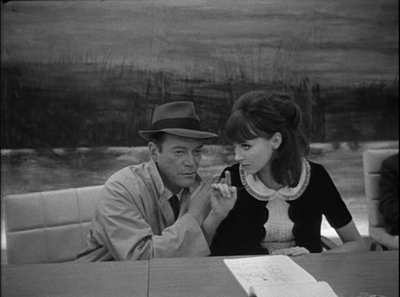
Alphaville [1965]

Yes! You see that correctly! I have in fact moved to the end of my time limit.

So, to do something I have actually done already at the very beginning of my time limit, let's take about French sci-fi! I present, Jean-Luc Godard's Alphaville: Une étrange aventure de Lemmy Caution or just Alphaville to most people.


Before I give a film history lesson, I want to mention how I decided to watch this movie. Two years ago I was reading After Dark by Haruki Murakami (for fun, not my minor and I still don't know how I feel about Murakami but I loved this book). In the book, the main character is asked to go to a love hotel to translate the testimony of a battered Chinese prostitute who was essentially left there to die so the employees can help her. The love hotel was called "Alphaville", a joke that was not lost on the main character who explained that it was a French film about a community that is not allowed to have emotion and that it's a fitting name for a place where people go to have meaningless sex. Right after, I watched the movie.

Now the director's name is probably somewhat familiar to film people as he was the director of À bout de souffle ("at breath's end") or Breathless as it's know outside of French places. This movie is often seen as the defining movie of the French New Wave using hand held cameras, no lighting, and lots of improv. I saw it before this one and honestly? I liked this movie better. Sure, it's not as "culturally significant" and the idea has been done before in many ways but I just enjoyed it more. And I have seen other New Wave era films that I actually enjoyed slightly more than Breathless.

So, I mentioned the idea has been done before? Orwell's 1984 and Bradbury's Fahrenheit 451 were both published before this movie was made and they both focus on a dystropia where emotions aren't really allowed. There were also plenty of movies and books after this film with that theme. Ever see Equilibrium?


Christian Bale does not understand the power of a cute puppy.

So what makes this movie unique? For one thing, the main character is not a member of the society who rejects it but a secret agent from outside the society going into it on a mission. He is constantly noting how strange Alphaville is in the way the audience is doing.

Another thing about this movie that is fairly contrary to most media about these emotion-free dystropias is the presence of sex. Alphaville does not treat sex in the same way as other medias do: as simply a means of reproduction. In Alphaville, a community that thrives on science and logic, a need for sex is seen as nature and not emotion and therefore, is okay. In the beginning of the movie when Lemmy arrives in his hotel in Alphaville, the women who showed him to his room, Beatrice, a "third class seductress," offers to bathe with him. These seductresses are commonplace.


The last thing that really sticks out about this movie is the setting. It is set in something of an alternative present. Everything looks like the 60s, there are no strange sets or effects, and it is clear that the world is not Alphaville and that this is just a small community that for the most part, looks the same as everywhere else. It is the attitudes and behaviors that are different.

So anyway, let's get into plot.


Lemmy Caution arrives in Alphaville, checks into a hotel and is taken to his room by the aforementioned third class seductress Beatrice. Nothing strikes him as particularly strange until he hears that each room has a Bible. When he asks her about it, she casually replies that they do believe in it and then mentions that there are tranquilizers in the bathroom, presumably the way they are able to remain so calm. She offers to bathe with him and he is attacked by a man hiding in his bathroom. He gets him out and Beatrice doesn't react at all to the incident.


Lemmy takes a picture of her since he has decided to photograph things he finds strange there, kicks her out, and then reveals that his purpose in Alphaville is to find a missing agent, Henry Dickson, and kill or capture the creator of Alphaville, Leonard Von Braun.


Natasha Von Braun, his daughter, comes to his room as she is the one with the job of showing around people from the Outlands. Lemmy compares her to a vampire, not an inaccurate comparison if you are thinking of the stunning emotionlessness of "Twilight" vampires. She talks about a festival that is coming to a close and they chat about things she doesn't understand.


I should point out that the movie has two narrators, one being Lemmy and the other being Alpha 60, a powerful machine that seems to function as an all-seeing eye around the city and sounds like a frog with a sore throat who has learned to speak. Alpha 60 alerts him of Natasha's arrival and waxes poetic on the danger of emotion.


In keeping with the ideas of science, all the places have names that honor science and math. Lemmy in particular is trying to get to "12, Enrico Fermi" (which happened to be the person my high school was named after).

While she is giving him a ride, she insists that he must check in at Residential Control and he says he will eventually and asks if he can meet her father. She says she has never met him but will try to arrange a meeting.


When Lemmy finds Henry Dickson he finds that Dickson has been somewhat brainwashed by the society he was sent to destroy as he had first been given the assignment of killing Dr. Von Braun. Dickson explains the town and Alpha 60 to him. To quote Wikipedia (as I am lazy), "Alpha 60 outlaws free thought and individualist concepts like love, poetry, and emotion in the city, replacing them with contradictory concepts or eliminating them altogether. One of Alpha 60's dictates is that "people should not ask 'why', but only say 'because'." People who show signs of emotion (weeping at the death of a wife, or a smile on the face) are presumed to be acting illogically, and are gathered up, interrogated, and executed." It is for this reason that people routinely ask Dickson to kill himself as he cannot assimilate fully.

The conversation between Lemmy and Dickson is interrupted when a seductress Dickson ordered entered and he ends up dying in the middle of sex. This is apparently common for the French.


He goes to visit Natasha at work where she is a programmer of Alpha 60 who repeats a lot of ideas that symbolize the society while they work.

Also, I want her outfit. I apologize for the emotional outburst.


Programming is very different in Alphaville. Why are women's eyes "yes" and men's eyes "no"? The differences between the sexes will come up again soon.

Lemmy admits that he doesn't understand any of Alpha 60's rantings. She explains to him how life and death are part of one continuous cycle and are meaningless and he says, "This dump of yours isn't Alphaville; it's Zeroville."


Lemmy takes a picture.
It's interesting how this women, in her choice of styling, appears to be flaunting her number, instead of simply concealing it by brushing her bangs in the opposite direction. A sense of pride in being a part of Alphaville, perhaps?

Natasha takes him to a government building where Von Braun is supposed to be and they witness the executions spoken of by Dickson.


I cannot help but wonder if this is supposed to be an insult saying that women lack emotion or a comment that women are more logical than men who are prone to behaving illogically.
It brings me back to the programming picture. Is the way a women views the world supposed to be preferred in Alphaville and that is why in the programming picture her eyes have been replaced with the word "yes"? It boggles the mind.


The first man they witness dying is guilty of the crime of crying when his wife died. He walks down a diving board, is shot executioner-style and then fished out of the water by women who resemble synchronized swimmers. The two men they witness the deaths of speak about the value of emotion and the cruelty of this city as their last words.


On the way out, Lemmy kidnaps Von Braun for a second before being captured by his body guards and beat up. Natasha cries for him but when they ask her if she is, she says, "No, it's forbidden."


The tears of foreshadowing.


Lemmy is interrogated by Alpha 60 about his purpose, name, age, etc. The machine suspects him of hiding things but does not know what so he lets him go. Lemmy ends up talking to a doctor who informs him that this building is the heart of Alpha 60 and that Professor Von Braun was once Professor Nosferatu and was expelled from the Outlands in 1964.


They show him around the building (the above is the Central Interrogation Station) and say that he could provide them with knowledge of what the Outlands are doing wrong, as they have just gone to war with them, and ask him why he shot the man hiding in his bathroom in the beginning (which was apparently a "Welcome to Alphaville!" test).


Alphaville is full of things like this, spiral staircases, straight lines, etc.

Lemmy leaves and proves that he has done his research on Alphaville. Apparently in the beginning those who could not assimilate were so plentiful, they were put in a theater and electrocuted while watching a show. The chairs were designed to dump the bodies afterwards Sweeney Todd style and then then another batch was allowed in. Stuff of nightmares. Also, apparently Germans, Swedes, and Americans were the best at assimilating. *insert joke about their emotionlessness here?*


He goes back to his hotel and Natasha is there hiding. She shows him the number on her neck called a control number. He shows her a book called "The Capital of Pain" full of words she has never heard before like "pain", "despair", and "conscience."


She goes to grab the Bible to look up the word, now making it clear that the Bible is actually a dictionary without any words that may provoke emotion. She actually seems a little sad that no one knows the meaning of the word "conscience" including herself. Recently "tenderness" and "autumn light" have been removed.

Lemmy, knowing Von Braun's history, proves to Natasha that she does remember things of the Outlands where she was born including descriptions of Tokyo, Florence, and New York.


Starting to remember, she decides that she wants to leave Alphaville but is afraid.


He tells her that he loves her and she initially does not understand but it intuitively clicks with her as she feels the same way.

Alpha 60, knowing everything, sends the police to capture Lemmy. Natasha admits that she will betray him and does so by telling a joke, causing him to laugh and therefore warrant arrest.

He goes before Alpha 60 again. He criticizes the machine and it condemns him to death. He responses logically by running away, shooting people, and getting a cop to drive him to Professor Von Braun.


Lemmy asks Von Braun to come with him to the Outlands and Von Braun asks him to say there. Lemmy shoots him. Guns solve all problems in this movie.


Alpha Cam!


Lemmy goes to get Natasha, who appears to have been experimented on by the government but the mention of love wakes her up somewhat from her drunken stumbling as they make their escape to the Outlands, having destroyed the system.


As they drive away, Natasha senses that Lemmy wants her to say something to him and asks him what but he tells her she must figure it out on her own. After some thinking she arrives at the conclusion:

"I love you."

Fin.


Allow me to share an unpopular opinion: crazy executions aside, I kind of like the basic idea behind the city of Alphaville. I would kind of love to live in a place primarily dictated by logic and, as a lot of people who know me would claim, I having trouble expressing emotion in kind of the same way Natasha does. Of course, a world of no emotion would be bad but I do believe the world could always use more logic.

Anyway, I like this movie a lot. There's a lot of New Wave directing moments which people are usually divided on but the actual plot is very palatable to any sci-fi fan.

Logic dictates that you should give it a try.

Monday, January 23, 2012

Special: The Artist [2011]

So far in writing entries on this blog I have not deviated from my stated film time periods but today I must make an exception with good reason.


Go see The Artist.

No, really.

If you give a care about old movies, and if you are reading this blog in any capacity, I hope you do, this is a film you need to see.

Let me break this down: this is a silent, black and white film about the film industry around 1929, specifically the moment when films switched from silent to talkies. It tells the story of George Valentin, a popular silent film actor whose life is destroyed by the change, and Peppy Miller, an up-and-coming actress who starts her career as an extra during the silent era only to be promoted to leading lady when sound is introduced. Their stories are connected, as Peppy's first step into the film industry is brought about by an encounter with George, and it is crazy to see how their roles reverse.

To avoid spoilers (and also because I need to keep this blog relevant to its topic) I have to point out the way the silent style was used in this film. For one thing, this movie did NOT in any way shy away from silent era conventions. It wasn't just a movie made in 2011 that happened to be silent; it was a silent film. The background music is used almost as a tool to facilitate telling the audience how they should be feeling, combined with the somewhat exaggerated (by today's standards) methods of expressing and emoting. Things that might be deemed as being too "cheesy" by today's screenwriters make their way into the film with ease, such as a scene where George's dog saves his life.

However, the movie is constantly aware of its silence and what this means to the characters of the film. One scene in particular that startled me was when George's wife approaches him one day with the dialogue card of, "Why can't we talk?" Not only is she speaking for all the fired silent film actors who weren't given their chance to speak, she is finally emphasizing the fact that throughout most of the film, George and his wife never talk. Initially I read this as a means to show how their relationship is weak because there are no dialogue cards but it runs deeper than that. No dialogue cards, no flapping lips, and even no expressions showing how they feel towards each other. They aren't talking in every way.

In another scene, one of only two with sound, George puts something down on his vanity and it actually makes a noise. There is no music playing so it is clear to the audience that this strange thing has just occurred and George acts similarly shocked by hearing the sound, preceding then to move around the other objects on the table to hear that they make noise as well. George is living in a silent world even though talkies now exist and he doesn't know how to handle being able to hear things in the same way the audience doesn't know what to make of this sudden shift from silence.

On a final note about the plot (no spoilers), I absolutely love the way the relationship between George and Peppy is portrayed. Although they have romantic chemistry, the film never tries to push towards romance, instead happy to relish in Peppy's sense of devotion to her idol and mentor and their mutual respect for each other. It's a refreshingly realistic element in a film full of seemingly "unrealistic" 20s/30s film conventions.

This movie really could and should have only been made 80 years after the silent film has fallen out of fashion. Aside from the obvious fact that the switch from silent film to talkies really did bring about hardships like the ones endured by George Valentin in this film that would have been rough on such actors too soon after their careers have fallen apart, the film proves to modern audiences that this "archaic" art form is still powerful and can still be employed to great effect. We now live in a world where films are hastily converted into 3D as a marketing ploy, where a "Transformers" movie can be the highest grossing movie of the year with its abysmal acting, sloppy script, and gimmicky special effects up the wazoo, but guess what? Movie magic can still be made without any of those ploys.

Seriously, why are you still reading?

Go see it.

Monday, December 26, 2011

The Seventh Seal [1957]

And as usual, my ability to update this blog with any consistency shows that I am made of fail. In all honestly, I had been trying to avoid movies made before 1965 as a way of keeping myself from feeling guilty about not updating. The fact is, I need a better format so I can more easily update without having to spend forever taking screen shots so that I will update more often. That experiment starts here.


So, what can I say about The Seventh Seal? It's one of the most famous Swedish films ever made by the most famous Swedish director ever. If you ask anyone on the street to name a Swedish director they will either stare at you blankly or say, "Ingmar Bergman" (or they might say "Ingrid Bergman" but she was a Swedish actress whose name is unfortunately similar). Bergman is Sweden's Kurosawa, Kubrick, Fellini and feel free to argue that I just overstated any of those directors' significances. I never claimed to be a film scholar.

Also, while I'm claiming ignorance I would like to point out that my knowledge of Swedish film is minimal, especially when compared to my knowledge of well, pretty much every other notable-film-producing country. My exposure to Swedish film boils down to these three things:

1.) Let The Right One In was a great movie.
2.) I've seen all the Millennium Trilogy movies. The first was the best.
3.) Ingmar Bergman is the most famous Swedish director and he has made quite a lot of films including Persona, Through a Glass Darkly, and The Seventh Seal.

One thing I recently heard about Bergman's films might be at least partially an explanation for his international fame: he makes movies that aren't about Sweden but are about people. This quality of universality seems to be prevalent in internationally known directors. Even if you look at how Kurosawa made a lot of movies involving samurai, a traditionally Japanese thing, a lot of his samurai films were remade into Westerns in the Western world with otherwise very little about them changed.

The Seventh Seal
's universal theme is the idea of facing your mortality and as a result, doubt in one's religious faith. When the film was made in the 50s this was likely a very relevant idea as it has been for hundreds of years. However, when you look at the film through the eyes of today, I find that I don't see it as topical anymore. Perhaps it is just my limited scope of the world but in the past it seemed that a good amount of the population was very religiously devoted almost out of obligation which is why so many people would suffer a crisis of faith like the main character, Antonius, does in this film. You were pulled into religion by your family or your society without ever giving you a real chance to question and explore whether or not the ideas seemed real to you. It was accepted as truth without much further thought for most or all of your life.

Nowadays it seems like people are starkly divided between those who have unwavering faith and those who have no faith. This does not mean there is not some in between area such as people who have no faith but want there to be an afterlife and people who have faith but may question or fear the exact structure of the afterlife they will enter. However, a crisis of faith in the modern world is rare. If you believe, you always believe. If you don't, you won't be convinced otherwise.

For Bergman, this movie seems very personal. His father was a Luthern priest who raised him on his beliefs and while Bergman says he stopped having faith at age eight, it took many years for him to cope with this idea. This movie shows that struggle very clearly in the behaviors of his characters, especially Antonius.

While I do question the relevance of the religious themes to a modern audience, the film is a great example of what those ideas were like in a time when religious devotion was so strong that some had to question it, the Black Plague, while still having been significant to an audience of the 50s. Also, the related themes of mortality and fear of death will always be important no matter what year you watch this movie. That, Bergman's superb direction, and all the iconic scenes that have been parodied one hundred times over will always make this film one that will always be a great work of art.

So by now it should be clear that this is a pretty serious movie but it is actually not without its comedy moments either. In the interest of simplicity, I will break down the plot quickly for those who have already seen it or who like to be spoiled beforehand. Expect silliness as I also can only be serious for so long. So here's "The Seventh Seal" a.k.a. "Road Trips, Chess Games, and Uninvited Dinner Guests."

The film starts with our protagonist, Antonius Block (that's not him), lying by the water side with his squire, Jons, and a chessboard after just coming home from the Crusades to hear that Sweden has been ravaged with the Plague. If you happen to be well versed in medieval times you might already be seeing the ingredients in the anachronism soup. There was a gap of time between the Crusades and the Black Plague in Sweden but Bergman seemed to forsake the particulars of history in favor of combining many comparative ideas that apply to the theme: a war based on religious holy lands and a disease that the religious populous thought to be divine punishment.


During their time lying in the sand, Antonius looks up to see a creepy dude with no eyebrows and a black monk-like robe standing before him. He identifies himself to be Death and says that he has been at his side for a long time. Antonius claims to be unafraid but before Death can claim him, he challenges him to a chess match, the terms being that as long as the game is going on he can live but that if he is defeated, Death can claim him. By totally random happenstance, Death is the black pieces.


The scene then cuts to Antonius and Jons, his squire, riding into town. Jons is the bitterly realistic comic relief sidekick as shown by his tendency to sing songs he made up about banging sluts and how Satan is with us. He asks a dead body for direction and is surprisingly chill by the man's lack of eyes. The man is a little too dead to answer but Jons says that he was very informative. Hint: plague.


They end up going past a caravan full of a performance troupe and the focus switches to them: the horny leader, Skat, and a happily married average guy, hot girl couple of Jof and Mia with their son Mikeal. Jof has visions of the Christ child. Mia thinks he's delightfully quirky.


On their first stop in town Jons encounters a painter painting a mural of the danse macabre and hears about how the Plague has brought on a bunch of people who whip themselves to try to show God that they are punishing themselves enough to have the plague removed. He talks bitterly but almost amused about how the Crusades are a useless endeavor. Antonius goes to confession about his religious doubts and fear of death, confessing to the priest that he is battling Death and reveals his strategy. Surprise! Death was in the confessional. Sneaky bastard.

On their way out they see a woman who will be burned to death for hanging with Satan*. More anachronism soup. Antonius asks the woman to arrange a meeting between him and the devil but she's too wonked out to give details.

Jons goes into a barn and sees a thief stealing jewels from a dead body. A woman comes inside and he threatens her so Jons jumps out and saves the day. He threatens to slice up the thief if he sees him again and tells the mute woman to be grateful for him valiantly not raping her and instead asks her to come along as his housekeeper. Their first road trip companion is on board!

During one of the stage troupe's performances, Skat runs off into the woods with some wench because his desire for nookie is stronger than his desire for money apparently. Then the show is interrupted by a procession of flagellants and monks pleading forgiveness. Buzzkill.
It looks kind of like crucified Jesus is holding back Jof and Mia from the priest giving the doom and gloom sermon. Weird foreshadowing?


After complaining that the procession was deary, Captain Obvious a.k.a. Jons gets asked by a smith named Plog if he has seen his wife who ran off with an actor. Inside the tavern he ends up asking Jof the same thing which leads to a showdown between the two of them and the thief from earlier who got himself involves for no reason. Jons comes in to break up the ruckus and cuts up the thief's face like he promised.

Antonius finds Mia and chats about her performance before Jof comes in and she treats his wounds. Jons and mute girl show up looking for Antonius and they all have a picnic and decide to be BFFs and road trip together.
Plog, having nothing better to do, decides to come along and they let him because they really need a fat, stupid guy to help round out their quirky cast.

Not long after they've left they see Skat and his hoe walking through the woods. Plog chases after him and Skat tries to defend the honor of Kunigunda, as she realistically told him her name was. Plog identifies her as "Rumpy, smutty, slutty Lisa", his wife. In spite of him calling her a tramp and a strumpet, she goes back to him and Skat hides in a tree. Death comes along and cuts down the tree while Skat asks desperately if there are exceptions for actors. This is the world before shows like "ET"; actors don't get exceptions from Death EVER, if anything they are bigger targets.


Jons is clearly unamused by Lisa's apology.

Casualties: 1 + everyone dead of plague
Road Trippers: 7

Antonius: The conflicted, kind but inactive protagonist.
Jons: The realist, bitter comic side kick.
Mute Girl: The eye candy/fetish fuel.
Jof & Mia: The jovial mismatched happy couple.
Plog: The fat, stupid one.
Lisa: The skank.

Wednesdays on Fox. 9/8 Central.

They run into the executors carrying off the witch girl from earlier and Antonius and Jons help so Antonius can ask her again if he can meet the devil and ask him about God. He quickly realizes that she is just crazy and mercifully gives her some pain killers before they burn her. They watch in morbid fascination as the fear of death finally crosses over her face and then leave to go make a campfire.


Their rendition of "Kumbaya" is interrupted by the thief from earlier showing up riddled with plague and asking for some water. Mute girl tries to give him some but Jons stops her and reminds her of the rule about not being a hero.


Death shows up to play chess with Antonius again. Jof can see Death but Mia insists that he is playing against himself. They start to sneak away and in an effort to do something significant before his inevitable death, Antonius knocks over the pieces to distract Death while they escape. And this is right after Death said nothing escapes him. While that's true in the long run, it seems that for now Jof, Mia, and Mikeal may be safe.

Death puts the pieces back in order and checkmates Antonius, saying that the next time they meet, he will take him.


The remaining trippers finally get to Antonius' castle, their final destination** and meet his rather stern wife, Karin, alone in the house since all the servants have run for it. The air around them is bleak and plaguey.

They all settle down for an awkward dinner party while Karin reads the verse from the Bible about the seventh seal that was said in the beginning of the film. Appropriate since they believe they are experiencing the Apocalypse. Then the worst thing ever happens: an uninvited guest shows up and they don't have enough meat to go around! He informs him that it's a Mr. Death here for something about the reaping*** and they all look at him in fearful awe except for mute girl who happily kneels before him. Apparently she had more backstory than we knew about.

When Jof and Mia wake up the next morning, Jof sees them with Death playing a game of crack the whip. He tells her he's seeing the dance of death of their friends and she tells him he's silly but Jof knows all great movies**** end with a dance party.


So anyway, Seventh Seal is a pretty great movie. If you are a camerawork nerd you will love Bergman's mise-en-scene, a philosophy/theology/lit nerd you'll love the theme, and just a regular person (*scoff*) you'll love the plot, characters, and bits of weird comedy.

Go rent it or else Death will come visit you and you'll have to play a game with him. I don't know if he takes requests but here's an idea.


* possibly more than hanging.
** I so clever.
*** Monty Python's Meaning of Life
**** Well, all Dreamworks movies which range from pretty good to dreadful. Although The Prisoner ended with a dance party and it was an amazing show.