Showing posts with label film noir. Show all posts

Sunday, March 11, 2012

Alphaville [1965]

Yes! You see that correctly! I have in fact moved to the end of my time limit.

So, to do something I have actually done already at the very beginning of my time limit, let's take about French sci-fi! I present, Jean-Luc Godard's Alphaville: Une étrange aventure de Lemmy Caution or just Alphaville to most people.


Before I give a film history lesson, I want to mention how I decided to watch this movie. Two years ago I was reading After Dark by Haruki Murakami (for fun, not my minor and I still don't know how I feel about Murakami but I loved this book). In the book, the main character is asked to go to a love hotel to translate the testimony of a battered Chinese prostitute who was essentially left there to die so the employees can help her. The love hotel was called "Alphaville", a joke that was not lost on the main character who explained that it was a French film about a community that is not allowed to have emotion and that it's a fitting name for a place where people go to have meaningless sex. Right after, I watched the movie.

Now the director's name is probably somewhat familiar to film people as he was the director of À bout de souffle ("at breath's end") or Breathless as it's know outside of French places. This movie is often seen as the defining movie of the French New Wave using hand held cameras, no lighting, and lots of improv. I saw it before this one and honestly? I liked this movie better. Sure, it's not as "culturally significant" and the idea has been done before in many ways but I just enjoyed it more. And I have seen other New Wave era films that I actually enjoyed slightly more than Breathless.

So, I mentioned the idea has been done before? Orwell's 1984 and Bradbury's Fahrenheit 451 were both published before this movie was made and they both focus on a dystropia where emotions aren't really allowed. There were also plenty of movies and books after this film with that theme. Ever see Equilibrium?


Christian Bale does not understand the power of a cute puppy.

So what makes this movie unique? For one thing, the main character is not a member of the society who rejects it but a secret agent from outside the society going into it on a mission. He is constantly noting how strange Alphaville is in the way the audience is doing.

Another thing about this movie that is fairly contrary to most media about these emotion-free dystropias is the presence of sex. Alphaville does not treat sex in the same way as other medias do: as simply a means of reproduction. In Alphaville, a community that thrives on science and logic, a need for sex is seen as nature and not emotion and therefore, is okay. In the beginning of the movie when Lemmy arrives in his hotel in Alphaville, the women who showed him to his room, Beatrice, a "third class seductress," offers to bathe with him. These seductresses are commonplace.


The last thing that really sticks out about this movie is the setting. It is set in something of an alternative present. Everything looks like the 60s, there are no strange sets or effects, and it is clear that the world is not Alphaville and that this is just a small community that for the most part, looks the same as everywhere else. It is the attitudes and behaviors that are different.

So anyway, let's get into plot.


Lemmy Caution arrives in Alphaville, checks into a hotel and is taken to his room by the aforementioned third class seductress Beatrice. Nothing strikes him as particularly strange until he hears that each room has a Bible. When he asks her about it, she casually replies that they do believe in it and then mentions that there are tranquilizers in the bathroom, presumably the way they are able to remain so calm. She offers to bathe with him and he is attacked by a man hiding in his bathroom. He gets him out and Beatrice doesn't react at all to the incident.


Lemmy takes a picture of her since he has decided to photograph things he finds strange there, kicks her out, and then reveals that his purpose in Alphaville is to find a missing agent, Henry Dickson, and kill or capture the creator of Alphaville, Leonard Von Braun.


Natasha Von Braun, his daughter, comes to his room as she is the one with the job of showing around people from the Outlands. Lemmy compares her to a vampire, not an inaccurate comparison if you are thinking of the stunning emotionlessness of "Twilight" vampires. She talks about a festival that is coming to a close and they chat about things she doesn't understand.


I should point out that the movie has two narrators, one being Lemmy and the other being Alpha 60, a powerful machine that seems to function as an all-seeing eye around the city and sounds like a frog with a sore throat who has learned to speak. Alpha 60 alerts him of Natasha's arrival and waxes poetic on the danger of emotion.


In keeping with the ideas of science, all the places have names that honor science and math. Lemmy in particular is trying to get to "12, Enrico Fermi" (which happened to be the person my high school was named after).

While she is giving him a ride, she insists that he must check in at Residential Control and he says he will eventually and asks if he can meet her father. She says she has never met him but will try to arrange a meeting.


When Lemmy finds Henry Dickson he finds that Dickson has been somewhat brainwashed by the society he was sent to destroy as he had first been given the assignment of killing Dr. Von Braun. Dickson explains the town and Alpha 60 to him. To quote Wikipedia (as I am lazy), "Alpha 60 outlaws free thought and individualist concepts like love, poetry, and emotion in the city, replacing them with contradictory concepts or eliminating them altogether. One of Alpha 60's dictates is that "people should not ask 'why', but only say 'because'." People who show signs of emotion (weeping at the death of a wife, or a smile on the face) are presumed to be acting illogically, and are gathered up, interrogated, and executed." It is for this reason that people routinely ask Dickson to kill himself as he cannot assimilate fully.

The conversation between Lemmy and Dickson is interrupted when a seductress Dickson ordered entered and he ends up dying in the middle of sex. This is apparently common for the French.
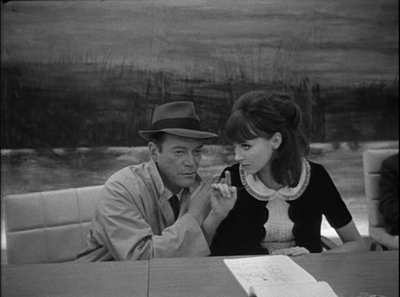

He goes to visit Natasha at work where she is a programmer of Alpha 60 who repeats a lot of ideas that symbolize the society while they work.

Also, I want her outfit. I apologize for the emotional outburst.


Programming is very different in Alphaville. Why are women's eyes "yes" and men's eyes "no"? The differences between the sexes will come up again soon.

Lemmy admits that he doesn't understand any of Alpha 60's rantings. She explains to him how life and death are part of one continuous cycle and are meaningless and he says, "This dump of yours isn't Alphaville; it's Zeroville."


Lemmy takes a picture.
It's interesting how this women, in her choice of styling, appears to be flaunting her number, instead of simply concealing it by brushing her bangs in the opposite direction. A sense of pride in being a part of Alphaville, perhaps?

Natasha takes him to a government building where Von Braun is supposed to be and they witness the executions spoken of by Dickson.


I cannot help but wonder if this is supposed to be an insult saying that women lack emotion or a comment that women are more logical than men who are prone to behaving illogically.
It brings me back to the programming picture. Is the way a women views the world supposed to be preferred in Alphaville and that is why in the programming picture her eyes have been replaced with the word "yes"? It boggles the mind.


The first man they witness dying is guilty of the crime of crying when his wife died. He walks down a diving board, is shot executioner-style and then fished out of the water by women who resemble synchronized swimmers. The two men they witness the deaths of speak about the value of emotion and the cruelty of this city as their last words.


On the way out, Lemmy kidnaps Von Braun for a second before being captured by his body guards and beat up. Natasha cries for him but when they ask her if she is, she says, "No, it's forbidden."


The tears of foreshadowing.


Lemmy is interrogated by Alpha 60 about his purpose, name, age, etc. The machine suspects him of hiding things but does not know what so he lets him go. Lemmy ends up talking to a doctor who informs him that this building is the heart of Alpha 60 and that Professor Von Braun was once Professor Nosferatu and was expelled from the Outlands in 1964.


They show him around the building (the above is the Central Interrogation Station) and say that he could provide them with knowledge of what the Outlands are doing wrong, as they have just gone to war with them, and ask him why he shot the man hiding in his bathroom in the beginning (which was apparently a "Welcome to Alphaville!" test).


Alphaville is full of things like this, spiral staircases, straight lines, etc.

Lemmy leaves and proves that he has done his research on Alphaville. Apparently in the beginning those who could not assimilate were so plentiful, they were put in a theater and electrocuted while watching a show. The chairs were designed to dump the bodies afterwards Sweeney Todd style and then then another batch was allowed in. Stuff of nightmares. Also, apparently Germans, Swedes, and Americans were the best at assimilating. *insert joke about their emotionlessness here?*


He goes back to his hotel and Natasha is there hiding. She shows him the number on her neck called a control number. He shows her a book called "The Capital of Pain" full of words she has never heard before like "pain", "despair", and "conscience."


She goes to grab the Bible to look up the word, now making it clear that the Bible is actually a dictionary without any words that may provoke emotion. She actually seems a little sad that no one knows the meaning of the word "conscience" including herself. Recently "tenderness" and "autumn light" have been removed.

Lemmy, knowing Von Braun's history, proves to Natasha that she does remember things of the Outlands where she was born including descriptions of Tokyo, Florence, and New York.


Starting to remember, she decides that she wants to leave Alphaville but is afraid.


He tells her that he loves her and she initially does not understand but it intuitively clicks with her as she feels the same way.

Alpha 60, knowing everything, sends the police to capture Lemmy. Natasha admits that she will betray him and does so by telling a joke, causing him to laugh and therefore warrant arrest.

He goes before Alpha 60 again. He criticizes the machine and it condemns him to death. He responses logically by running away, shooting people, and getting a cop to drive him to Professor Von Braun.


Lemmy asks Von Braun to come with him to the Outlands and Von Braun asks him to say there. Lemmy shoots him. Guns solve all problems in this movie.


Alpha Cam!


Lemmy goes to get Natasha, who appears to have been experimented on by the government but the mention of love wakes her up somewhat from her drunken stumbling as they make their escape to the Outlands, having destroyed the system.


As they drive away, Natasha senses that Lemmy wants her to say something to him and asks him what but he tells her she must figure it out on her own. After some thinking she arrives at the conclusion:

"I love you."

Fin.


Allow me to share an unpopular opinion: crazy executions aside, I kind of like the basic idea behind the city of Alphaville. I would kind of love to live in a place primarily dictated by logic and, as a lot of people who know me would claim, I having trouble expressing emotion in kind of the same way Natasha does. Of course, a world of no emotion would be bad but I do believe the world could always use more logic.

Anyway, I like this movie a lot. There's a lot of New Wave directing moments which people are usually divided on but the actual plot is very palatable to any sci-fi fan.

Logic dictates that you should give it a try.

Tuesday, April 19, 2011

Sunset Boulevard [1950]

It's the movie about the movies with so many quotable lines that you have probably heard before and didn't know where they were from.

Also, I have finally moved into the 1950s. Well, the very beginning at least.


I don't know what to say about this movie to be honest.

It's the story of a narcissistic and delusional silent film actress who has been living in seclusion since the popularity of talking pictures and the struggling screenwriter who becomes her kept man.

And it's amazingly directed by Billy Wilder.

And the acting is awesome.

And the dialogue is hilarious and memorable.

And it lost Best Picture to All About Eve. Apparently 1950 was a good year for movies as one of my personal favs Born Yesterday was also nominated.

But it did win for Best Writing, Art Direction, and Music. This post will hopefully make two of those three clear (I don't know how I would show music since YouTube only has clips from the musical Sunset Boulevard which in spite of my love of musicals, I know nothing about except there is one clip of John Barrowman singing and being a Doctor Who fan that made me happy).


The main cast: William Holden (Joe), Gloria Swanson (Norma), Nancy Olson (Betty), and Erich von Stroheim (Max).

Swanson was a silent film actress who's career fizzled with the talkies and the other actresses considered for the role (like Mary Pickford) where in the same situation. This casting idea along with a bunch of cameos from people in the music industry adds a level of realism to the picture that must have been eerie at the time. In fact, when Swanson was being considered for the role they asked her to come in for a screen test and she asked if it was really necessary since she had made 20 films with Paramount in the past. Art imitates life.

So thematically this was a controversial film at the time. The wounds of the silent film stars who couldn't cross over into talkies were still festering after about twenty years and many were rather angry. On the contrary, a lot of people seemed to like it and see it as a film that would last. Guess who wins?

Also, after A Trip To The Moon it must be nice to look at clear pictures, huh? I sure appreciate it.


So the film starts with a shot of the street name painted on the curb before following the road to where a bunch of cop cars are driving.

Apparently the opening scene of the movie was actually supposed to be a scene of a Hollywood morgue with a bunch of corpses chatting about how they died leading our deceased narrator, Joe Gillis, to start telling his story which is the movie. The scene confused the test audience who wasn't sure what type of movie they were in for so they took it out.


Joe: "The poor dope - he always wanted a pool. Well, in the end, he got himself a pool."

Joe is an amusing narrator. He makes a lot of snarky comments and crazy descriptions. This is a noir film after all.
He tells us that there has been a murder at the home of a famous actress. Gee, I wonder who got killed . . .


Um, spoiler? I guess we didn't need his corpse to talk after all.


Repo: "This car better be back here by 3PM or there are gonna be fireworks"
Joe: "You say the cutest things."

So we back up to Joe living in a shanty apartment, trying desperately to figure out if the problem with his movie scripts is that his ideas "aren't original enough or too original" since no one is clamoring to buy them. He is visited by the repo men since he is three payments behind on his car. He needs $300 and now.


Product placement!


He goes to see a man about his script only to hear that it isn't very exciting. His script reader comes in telling him it's total crap not knowing that the writer is standing behind her. Good first impression.

Betty: "Right now I wish I could crawl into a hole and pull it in after me."
Joe: "If only I could be of any help."

Think she might show up again?

Needless to say, they don't buy the script.


The pharmacy. The meeting place of the 1950s according to Joe.


"Of course, I could give you $300 but I'm not going to . . . The finest things are written on an empty stomach."

After making some calls regarding the money he needs, he goes to bug his agent. His agent gives him the above advice. Subtext: Suffering is good for you and I'm selfish.


In a mild chase scene from the repo men, Joe parks in what seems to be an abandoned garage to hide his car for now.


"It was a great big white elephant of a place, the kind crazy movie people built in the crazy 20s."

So obviously, this means he has to go check it out. Because nothing bad ever comes from inspecting deserted buildings. Nothing.


The doorman tells Joe that they have been expecting him and Joe, still surprised that someone actually lives there, tries to insist that he's only here because of his car issues.


Regardless, he is ushered upstairs to where the owner of the house resides in a room bound to induce schizophrenia (spoiler?) and she immediately starts talking: "I'd like the coffin to be white, and I want it specially lined with satin. White... or pink. Maybe red! Bright flaming red! Let's make it gay!"

Who says you should go out with dignity? Go out with eye-searing gaudiness!


. . . And she was talking about the death of her pet chimp. Well, at least now the "bury him in the garden" comment is way less creepy.


After Joe admits that he is not a funeral director and she starts pushing him out the door, he recognizes her as Norma Desmond, the famous film star.

Joe: "You used to be big."
Norma: "I am big. It's the pictures that got small!"


After hearing that Joe is a screenwriter, she shows him a slew of scripts for a movie adaption of "Salome" that she has been writing for years, of which she is going to use to make her "return" (she doesn't like the word "comeback").

She tells him to read it. His response: "Sometimes it's interesting to see just how bad bad writing can be. This promised to go the limit."


She decides to pay Joe to fix it up for her but refuses to let the script leave the house, offering him the room above the garage for the night. Max the butler tells stories of Norma's (former) greatness.


Joe critiques the faded unkempt tennis court and rat-infested pool (symbolism) and watches the "last rites of that chimp performed with the utmost seriousness as if she was laying to rest a first child." More symbolism.
The chimp = her only friend outside of Max.


Yeah, finals do suck.


There is something indescribably creepy about seeing someone's fingers moving that fast and that close to the screen. It's like two Things from The Addams Family putting on a show.


She likes to sit surrounded by pictures of herself. Not at all weird.

She offers him a job to continue working on the script while she sits around reading fan-mail, signing pictures, and bothering him to not delete any scenes with her in them.


Every once in a while they watch her old movies.

The great thing about Swanson in this movie is how she plays Norma like she is constantly in a silent movie. Everything is drama. Everything is facial expressions and hand gestures. This particular hand gesture says a lot. As does Joe's reaction to it.


Hang on. I need to step into my crazy light with the smoky backdrop for EMPHASIS!


Joe starts actually leaving the house with her when she decides that his clothes are trashy and he needs to get something more high-end that she will pay for.


Norma then moves Joe into a bedroom in the main house right across from hers. I'm sure that was an innocent suggestion.


Max tells Joe that there are no locks in the house at all per the doctor's suggestion. Norma is on constant suicide watch. Max also says that the fan-mail that Norma gets is written by him to keep her spirits up. Talk about sad.


On New Year's Norma throws a party. She is unaware how pathetic it is.


After giving Joe a solid gold cigarette case, Joe gets angry at her for trying to essentially hold her hostage out of loneliness. Norma takes it well.


Artie: "Fans, you all know Joe Gillis, the well-known screenwriter, uranium smuggler, and Black Dahlia suspect!"

This is how I'm going to introduce all my friends at parties from now on although obviously I will tailor it slightly to fit them.

Joe runs out to meet up with his friend Artie at a rocking party where he meets his new girlfriend.


Shocker! Artie is dating Betty who apparently dug up some of his old scripts and found 6 pages of one of them that she actually liked.


Betty discusses building a movie around those 6 pages and Joe promptly starts seducing her with film lines which she is able to complete. They are quite cute together because they are both so witty and biting without being mean.


Buzzkill comes in the form of a call to Max who says that Norma tried to slit her wrists and Joe, in guilt, rushes back to the mansion.


Joe has 50s-fade-to-black pity sex with her and they pretend his runaway thing never happened.


While stopping at the drugstore to buy Norma some cigarettes, Joe runs into Artie and Betty. Betty tells him that the studio is interested in their movie idea but Joe tells her he can't help her.


Back at the mansion, Norma tries to amuse Joe with her Charlie Chaplin impression. It's not the turn-on one might expect.


Norma hears from the director Cecil B. DeMille and, assuming it's in regards to her script, she pops over to the lot to find that the guard actually DOES remember her and allows her inside when everyone else turns her down.


While there a lighting guy who she knew shines a spotlight on her, drawing interested cast and crew to her side. Obviously, she's in heaven.


Joe: "Psychopaths sell like hotcakes!"
Betty: "This is a story about teachers, their lives, their struggles!"

Seeing Betty on the lot, Joe rushes over to her office and says he would like to work on their new idea and they start shouting out thoughts.

Also, I call *meta-alert* on Joe's quote.


Joe and Max find out that the studio only contacted Norma because they wanted to use her very old car in a movie. They don't tell her and she starts getting crazy beauty treatments (i.e. plastic surgery) to prepare for her "return."


Norma starts to get suspicious of the fact that Joe is leaving the house a lot more than usual. The death grip on his head says it all.


Joe: "It's from a middle aged lady. Very foolish and very generous."
Betty: "Oh, the old familiar story. You help a timid little soul cross a crowded street and she turns out of be a multi-millionaire and leaves you all her money."
Joe: "That's the problem with you readers: you know all the stories."


Betty tells Joe about how she comes from a family of people in the film industry and that she was encouraged to act only to be told that her nose is crooked. After fixing it, they told her her acting sucks and she decided to follow another path in the business.

Joe says he likes her nose and cuteness ensues.

A buzzkill comes from the revelation that she is 22, a bit too young for Joe but not scandalously so, and he decides it's best things remain platonic. Sorta.


Max discovers him sneaking back inside and reveals that he was once a great director and Norma's first husband who voluntarily gave up his career to watch over her. I think I find Max to be more deserving of my sympathy than Norma, honestly. Dude's hopelessly in love and has to watch her screw around with her boy-toy in front of him.


Dun, dun, dun! Norma finds the script!


Betty revels that Artie wants to get married and Joe doesn't get why this is a problem.


Then he figures it out.


Norma makes a call to Betty threatening to tell her things about Joe that she doesn't know. Joe walks in, grabs the phone, and tells Betty to come over and see for herself, much to Norma's dismay.


Norma: "Don't just stand there hating me! Shout at me! Strike me! But don't hate me! Say you don't hate me, Joe!"


Joe shows Betty the house and tells her the whole situation, playing the I'm-just-a-gigantic-douche-you-don't-want-me card because he thinks it's what's best for her. She leaves in sadness.


Norma shows Joe the gun she bought to off herself with while he packs to leave. He admits the truth about the fan-mail and her movie script's failure.

Joe: "Oh, wake up, Norma, you'd be killing yourself to an empty house. The audience left twenty years ago."


Norma: "Did you hear him [Max]? I'm a star!"
Joe: "Norma, you're a woman of fifty, now grow up! There's nothing tragic about being fifty. Not unless you're trying to be twenty-five."

Serious words to live by there.


Joe tries to leave and is shot and killed by Norma, causing him to fall into the pool. We have come full circle.


The police try to interrogate Norma but at this point her mind is so gone that all she can talk about is preparing for her movie.


Achieving her wish, she is back on camera again preparing to act her movie role to a newsreel as she says her final lines through increasingly Gaussian filtering.

Norma: [to newsreel camera] "And I promise you I'll never desert you again because after 'Salome' we'll make another picture and another picture. You see, this is my life! It always will be! Nothing else! Just us, the cameras, and those wonderful people out there in the dark!... All right, Mr. DeMille, I'm ready for my close-up."


This is a classic of cinema and in particular, film noir.

Seriously, go watch it.