So you could say I'm still following a pattern with this choice of movie in some fashion because this movie is from the same year as The Blue Angel but while still being a downer like the last one it:
1.) is not a German movie but an American movie about German kids, directed by Lewis Milestone, a Russian-American.
2.) it doesn't have Emil Jannings in it.
3.) and it is a war movie, a genre which I have not done yet.
I apologize in advance because this entry will not be very funny compared to my previous entries because a movie like this doesn't lend itself to much comedy and I can only go to hell so many times. Instead while I will be doing the usual shot-for-shot format, it will be more to talk about specific portions than every detail of the plot. I also want to talk about the genre of war movies in a general sense.
On a personal note, a good portion of my friends tell me that I need to stop watching war movies (my friend Alex in particular warned me against something called "Generation Kill"). Currently one of my best friends in the world and platonic soul mate (who my family wants me to marry) Adam is in Afghanistan with the U.S. Marine Corps. This should mean that I don't want to watch war films but for some reason, it doesn't. It could be that he's only been gone less than a month so I'm having a hard time wrapping my mind around reality or that there's a disconnect in my mind between a war movie and the fact that he's actually in a war. I don't know. Either way, I'm apparently still watching war movies and I'm dealing with everything okay (with the exception of one nightmare so far; I'll keep a tally).
So, war movies.
Technically one of the first fictional movies that can fall into the war genre is Birth of a Nation [1915] which is, in a word, difficult to watch. It's about four hours long and, well, racially insensitive? I'm not quite sure how to put it appropriately unless you have seen it. It depicts the Civil War in a manner more reflective of WWI which was going on at the time.
There were a few other significant war movies of the silent era that were fictional and some that were more of the nonfiction, propaganda sort but when it comes to talkies, All Quiet On The Western Front was really the big front runner of the idea that war is not something to be glorified taking a cue from the silent film The Big Parade [1926] a few years earlier. To be honest, this is probably one of the earliest war movies I have seen (other than Birth of a Nation) that was made in the time period constrained by this blog but there are a few others I would like to see, particularly Paths of Glory [1957], Bridge on the River Kwai [1957] and I would like to write about Dr. Strangelove [1964] when I eventually start feeling modern because I love that movie.
Since Western Front many war movies have been released with many different angles to them and taking place during different wars. However there does seem to be one consistent theme with all war movies. War movies, unlike other genres like action and comedy, do not set out with the simple goal of, "This movie is made to entertain the audience." While everyone who works on a movie does so to capture the attention of the audience in some fashion, war movies always set out with a specific message.
In the beginning, war movies generally had two sides:
War is Glorious
and
War is Hell
and for a time they were mutually exclusive. Western Front was made around this time. You could generally divide early war films as being either of the two categories above or a comedy that doesn't try to answer any great question and simply entertains. Propaganda films would always take the side of Glory and comedies, if you had to put them somewhere, would also fall on a distorted version of Glory as well. However, in the wake of WWI there was an equal call for movies that realistically showed the Hell of war to combat the Glory ideals that was being shoved down their throats prior to the war. This kept the two sharply separated.
Somewhere along the line (definitely by the mid-60s but maybe earlier; I'm not a film historian, just a fan), these categories started to blur to the point where a movie could be all three. Now the "war comedy" doesn't really exist (Stripes [1981] is the latest one I can think of), or more likely, it does but through a different filter than what war comedies used to be. Now if there is comedy in a war film it is not seen as a comedy but "a war movie that has some funny parts" (300 [2007] in particular comes to mind; it is also a perfect example of the Glory idea; the freaking tagline is "Prepare for Glory" BUT everyone still dies in the end so there is some Hell).
Either way, the majority of war movies that came out after the time period I write about emphasize War Is Hell and tend to shy away from War Is Glorious unless it is about a war that takes place far in the past, typically in the time where the Western world consisted of tribes and war was always seen as a part of life and a right of passage.
Of course, because the simple idea of War Is Hell can only get you so far when the idea has been around since 1926, war movies started having to come up with their own unique ways of ending that simple sentence in a more specific manner:
War Is _________.
As I mentioned before, I have seen a good amount of war movies. I'm not a connoisseur but I try and I can try to fill in this sentence for some movies.
Dr. Strangelove [1964]:
War is the result of misplaced masculinity and libido.
Apocalypse Now [1979]:
War is an uncivilized retreat to our animalistic nature.
Full Metal Jacket [1987]:
War is conducted through brainwashing out one's humanity.
Saving Private Ryan [1998]:
War is rarely but occasionally merciful.
Flags Of Our Fathers [2006]:
War is misinterpreted and used as a tool by those who don't fight.
Letters From Iwo Jima [2006]:
War is a win for you but a lose for the other side who are merely people like you.
The Hurt Locker [2009]:
War is a drug.
And so on.
Now back to All Quiet On The Western Front specifically. Considering the fact that this movie was made in 1930 and has since had many war films following its traditions and ideas, I was legitimately surprised at how many scenes in this movie were really emotionally affecting and even unique to compare to my prior viewing experiences. That's a movie that stands the test of time right there. When you can see a movie 80 years after it was made and after seeing 1158 other movies in your life (yes, I keep count) and still have it surprise you, that's something.
(Side Note: If the links to TV Tropes were not clear enough I could give you some musical examples. For War Is Glorious listen to "Glory" from the musical Pippin and "The Soldering Life" by The Decemberists. For War Is Hell try "War Pigs" by Black Sabbath or any war-themed song by Metallica. For a combination of both try "Stand To Attention" by Bitter Ruin or for a satirical combo try "War Song" from Threepenny Opera.)
On with the show.

In the opening scene the viewer is treated to the civilian's idea of being a soldier as a bunch of troops march proudly through town while everyone greats and honors them for their sacrifice. Keep in mind that this is the beginning of WWI, 1914 so there currently are no War Is Hell accounts and if there are, they are considered incongruous with the War Is Glorious ideas that are prevalent and shown through "real life" scenes like this.

"This is what we must do: strike with all our power, use every ounce of strength to win victory before the end of the year."
Here we have Kantorek, a German high school teacher (who I can only assume teaches Greek based on the chalkboard behind him). Amid all the celebration for the troops outside, he gives a passionate speech about the merits of fighting for the Fatherland with clearly disillusioned ideas about how long a war lasts and what it really entailed.

Equally as ignorant, the boys fantasize about what it would be like to be a soldier, only contemplating the effects of a return to their homes and not the war itself. Here a boy imagined his father's proud expression at seeing his son in uniform.

Here a boy imagines being the head of a parade for the returning troops with a girl on each arm.

Thoroughly convinced, the boys all leap up in joy and decide to enlist instead of finishing school properly and the teacher is overjoyed with his success

"Anything you say, general."
On the way to basic training, the boys laugh and joke.

Perhaps I am too American or something but this just doesn't seem like something you would do with your friends.

The boys are amused to find that their drill sergeant is their postman and they try to talk casually with him and joke around but he will not have any of it.

They go through training which consists mostly of marching with some minor rolling in mud; clearly not sufficient training for a war.

The boys get revenge on the postman one night when he stumbles back to camp drunk and they throw a blanket over his head and wack him on the bum with sticks. This shows their immaturity and misbehavior that remains unaltered by the training. Clearly he was not like the drill sergeant in Full Metal Jacket.

After being shipped out to the war with such minimal training, they find themselves in over their heads as one of the recruits dies before they even get to their post.

At the post populated by older, more experienced soldiers (Katczinsky, Detering, Westhus, and Tjaden) they learn that food is scarce and they must pay for it with cigarettes and soap because money is useless.

Kemmerich: "He's dead!... He's dead!"
Katczinsky: "Why did you risk your life bringin' him in?"
Kemmerich: "But it's Behn! My friend!"
Katczinsky: "He's a corpse - no matter who it is... Now, don't any of you ever do that again!"
One of the boys is shot down while they are setting up camp and they quickly learn the value of human life out on the front.

Kemmerich, after the traumatizing experience earlier starts having nightmares and muttering to himself.

In a panic, he tries to escape the trench only to be shot and rushed to the hospital.

This right there is the image that stays with me from this movie. Outside of the gruesome aspect of it, there are so many other things that I consider looking at it including both the fact that this is a movie effect in 1930 and the symbolism here.

After an attack from the French, the company reports at mealtime where the cook refuses to serve them until the whole company has showed up only to find that what was once a company of 150 men has been reduced to 80. The remaining soldiers rejoice at the prospect of double portions.
"We're the Second Company and if only half of us get back, that's our good luck. Come on, dish it out!"

Tjaden: "Well. how do they start a war?"
Kropp: "Well, one country offends another."
Tjaden: "How could one country offend another? You mean there's a mountain over in Germany gets mad at a field over in France?"
Over lunch they have a not-so-serious discussion about war.
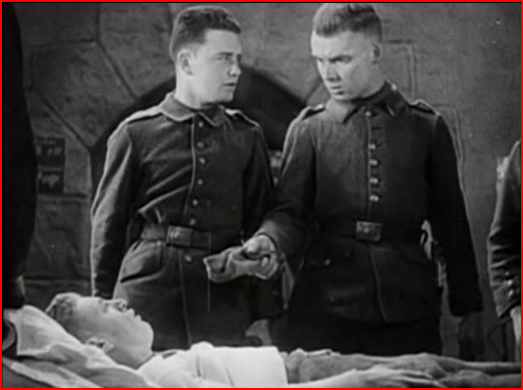
During a visit to the injured Kemmerich, he complains about his foot hurting only to have Muller let slip that his leg has been amputated.

Insensitively Muller comments on the quality of Kemmerich's boots and asks if he can have them since Kemmerich won't be walking around anymore.

All the boys soon leave except for Paul who tries to make Kemmerich feel better by reminding him that he will be sent home now only to have Kemmerich die after telling Paul that Muller can have his boots.

Later during another attack from the French, Paul ends up stabbing a French soldier with his knife.

Paul is stuck in the area with the soldier who is dying and he tries to help him by giving him water to drink and looking after him.

"You won't die! They're only little wounds! You'll get home! You'll be alright! You'll get home long before I do!"
As and when the man eventually dies, Paul begs him for forgiveness for what he had done.

"I'll write your wife! I'll write to her! I promise she'll not want for anything."
Paul promises the corpse.

At a bar, the boys talk about girls as military men often do.

They meet a few French girls who they spend the night with in a brief moment of happiness.

Paul is sent to the hospital after an attack where Kropp and an older man are recovering.

After being warned about a room no one comes back from by the older soldier, Paul is then wheeled into the room screaming about how he will return to the regular room and be okay.

Unable to tell Kropp his leg has been amputated the older soldier tries to distract him by telling him that he looks fine.

No words.

Paul returns home on leave to find that his mother is ill and that he cannot talk about what he has been through.

Paul goes back to the teacher that encouraged them all to join the the first place. The teacher is proud and tells him to tell the class what his experience with war was like only to have him initially reply with, "We live in the trenches out there. We fight. We try not to be killed, but sometimes we are. That's all."
Dissatisfied with his answer, the teacher pushes him to say more about the glory and pride of war to which Paul snaps saying instead, "We used to think you knew. The first bombardment taught us better. It's dirty and painful to die for your country. When it comes to dying for your country it's better not to die at all! There are millions out there dying for their countries, and what good is it?"

Unable to hand the pressures of being soldier in a civilian world where no one understands, he cuts his leave short saying he wants to find Katczinsky, one of the bitter, older soldiers who taught him how to survive and the only one of his original group left.

"It's not home back there anymore. All I could think was, I can't wait to get back home and see Kat again."

They are soon attacked while talking and Kat is injured so Paul carries him to the medic's tent while talking about how everything is going to be fine and they are going to remain friends after the war is over.

Upon arriving in the tent, the medics point out that Kat is dead and carelessly return to their card game while Paul solemnly leaves.
Note the scene composition.

Back in the trench, Paul sees a butterfly perched near him and reached out to touch it.


And he finds his end in an act of hope.
So what is there left to say on this?
It is a great movie.
Kind of a day-ruiner.
But I like that in a film.